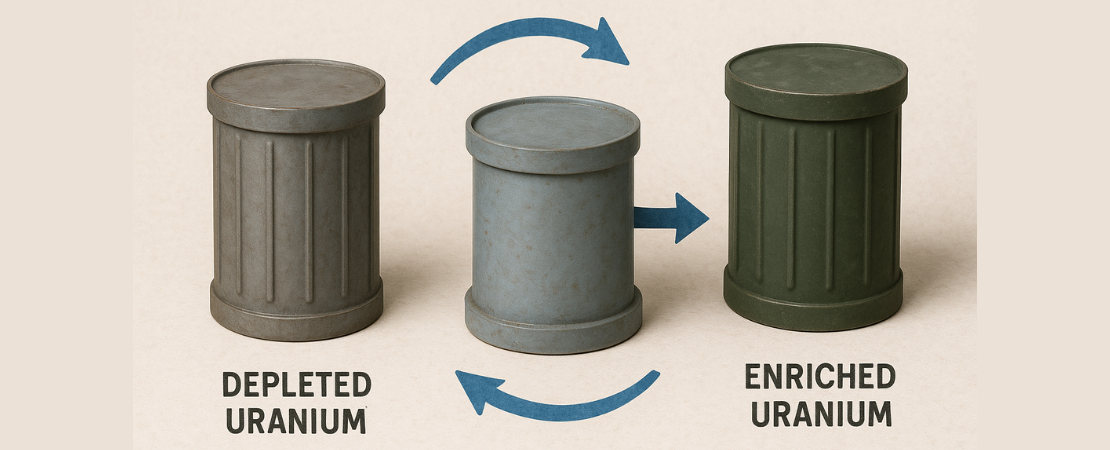


When looking at any projections of uranium supply and demand it’s critically important to remember that what utilities actually purchase to make their fuel is enriched uranium: sometimes called LEU (for “low-enriched uranium”) or EUP (for “enriched uranium product”). Enriched uranium is a combination of uranium and enrichment.
The easiest way to understand this is to think about making orange juice. To make OJ, you need oranges and you need squeezing, so think of the oranges as uranium and the squeezing as enrichment. To make a given quantity of orange juice you can either use a lot of oranges and just squeeze them a little bit or you can use very few oranges and squeeze the daylights out of them. Making enriched uranium is the same: you can either use a small amount of uranium and a lots of enrichment or a lot of uranium and smaller amounts of enrichment. This is something the utility customer determines based on their relative costs of uranium and enrichment, but it’s also something the enricher then determines, depending on their cost of enrichment versus the market value of uranium.
When a utility signs an enrichment contract, they agree with the enricher how much natural uranium (in the form of UF6) the utility will supply and how much enrichment they will purchase from the enricher (measured in SWU’s, which is the unit of measurement in which enrichment is sold). The utility determines these quantities based upon their cost of uranium and enrichment. Once the contract has been signed, however, the enricher is free to use any combination of uranium and enrichment they want, so long as they deliver the agreed-upon quantity of enriched uranium specified in their contract with the utility.
 For most of the past two decades, the world’s enrichers have used less uranium than they received from their customers and more enrichment than their customers purchased under their enrichment contracts to produce the agreed-upon quantities of enriched uranium. This is referred to as “underfeeding” and enrichers did this because the value of uranium was comparatively higher than the enricher’s cost of producing enrichment. The enricher would produce the agreed-upon quantity of EP for their utility customer, but would end up with extra, unused uranium which they had received from their customer under their enrichment contract. The enrichers could then either sell this UF6 into the market or enrich and sell it as a EUP. Either way, this resulted in more uranium being available in the market than would have been the case had the enricher used the amounts of uranium and enrichment specified in their contract with the utility.
Any supply and demand scenario will assume that a certain amount of enrichment and a certain amount of uranium Is being used to produce the quantities of EUP needed by the world’s utilities. This is reflected in what is called “tails assay,” which is a measure of how much enrichment is being used to make EUP. The only people who know how much enrichment and how much natural UF6 is truly being used to produce EUP are the enrichers themselves.
As of today (July 2025) it is estimated that the world’s enrichers are still “under feeding” (i.e., using less uranium that is specified in their enrichment contracts to produce the agreed-upon quantity of EUP for their utility customers), although they are underfeeding less than they were previously. This means they are using more uranium than they had previously to make the same quantities of EUP needed for the world’s reactors. It also means there is less extra uranium now available in the market than there was previously.